Video paused
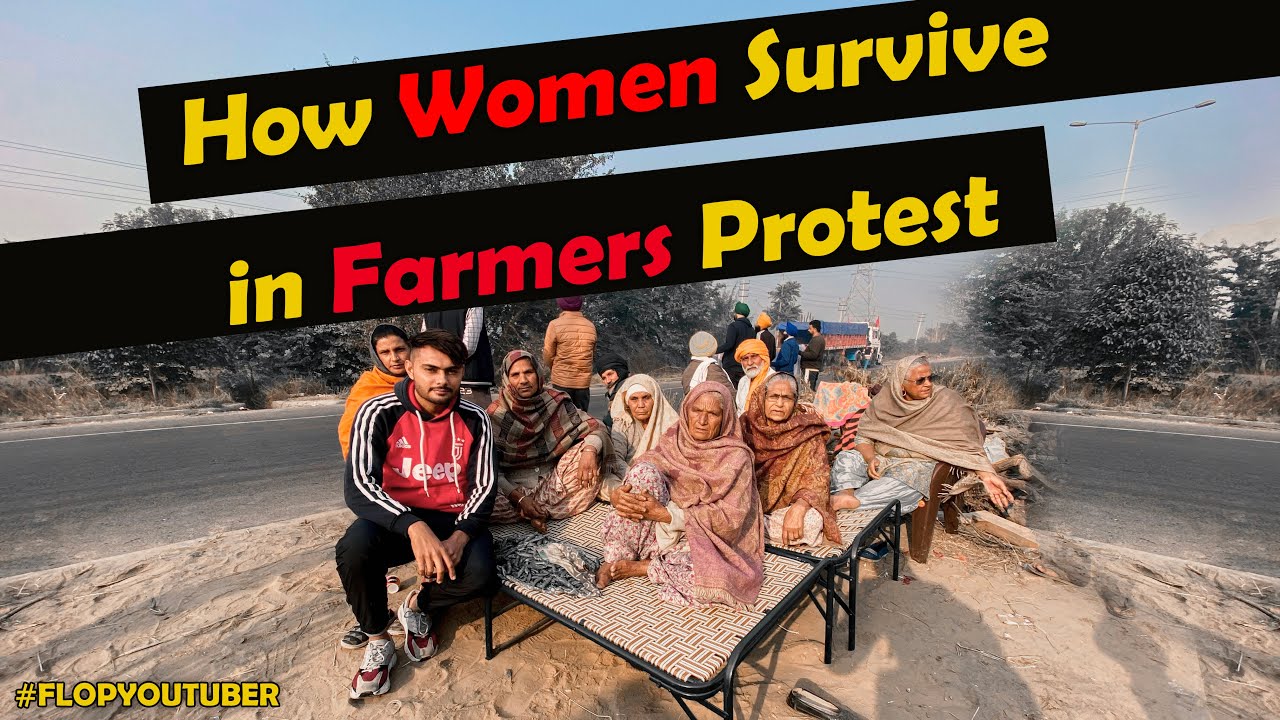
How Women Survive In Farmers Protest
Playing next video...
How Women Survive In Farmers Protest

The 2020 Indian farmers' protest is an ongoing protest against the three farm acts which were passed by the Parliament of India in September 2020. The acts have been described as "anti-farmer laws" by many farmer unions,[3][4] and politicians from the opposition also say it would leave farmers at the "mercy of corporates".[5][6] The government, however, maintains that they will make it effortless for farmers to sell their produce directly to big buyers, and stated that the protests are based on misinformation. Soon after the acts were introduced, unions began holding local protests, mostly in Punjab. After two months of protests, farmer unions—notably from Punjab, Rajasthan and Haryana—began a movement named 'Dilli Chalo' (transl. Let's go to Delhi), in which tens of thousands of farmer unions marched towards the nation's capital. The Indian government ordered the police and law enforcement of various states to attack the farmer unions using water cannons, batons and tear gas in an effort to prevent the farmer unions from entering into Haryana first and then Delhi. On 26 November, a nationwide general strike that, involved approximately 250 million people took place in support of the farmer unions.On 30 November, India Today estimated that between 200,000 and 300,000 farmers were converging at various border points on the way to Delhi. Over 50 farmer unions have been protesting, whereas the Indian Government claims some farm unions have come out in support of the farm laws.Transport unions representing over 14 million trucker drivers have come out in support of the farmer unions, threatening to halt movement of supplies in certain states. After the government did not accept the farmer unions' demands during talks on 4 December, the farmer unions planned to escalate the action to another India-wide strike on 8 December 2020. The government offered some amendments in laws, but unions are asking to repeal the laws.From 12 December, farmer unions took over highway toll plazas in Haryana and allowed free movement of vehicles.By mid December, the Supreme Court of India had received a batch of petitions related to removing blockades created by protestors around Delhi. The court also intends to take forward the negotiations with the various bodies of protesting farmer unions.The court also asked the government to put the laws on hold, which they refused. In 2017, the central government released the Model Farming Acts. However, after a certain period of time, it was found that a number of the reforms suggested in the acts had not been implemented by the states. A committee consisting of seven Chief Ministers was set up in July 2019 to discuss the implementation. Accordingly, the central Government of India promulgated three ordinances (or temporary laws) in the first week of June 2020, which dealt with agricultural produce, their sale, hoarding, agricultural marketing and contract farming reforms among other things.These ordinances were introduced as bills and passed by the Lok Sabha on 15 and 18 September 2020. Later, on 20th and 22 September, the three bills were passed by the Rajya Sabha, where the government is in a minority, via a voice vote - ignoring the requests of the opposition for a full vote.The President of India gave his assent by signing the bills on 28 September, thus converting them into acts. These acts areas are: Farmers' Produce Trade and Commerce (Promotion and Facilitation) Act : expands the scope of trade areas of farmers produce from select areas to "any place of production, collection, and aggregation." Allows electronic trading and e-commerce of scheduled farmers' produce. Prohibits state governments from levying any market fee, cess or levy on farmers, traders, and electronic trading platforms for a trade of farmers’ produce conducted in an 'outside trade area'. Farmers (Empowerment and Protection) Agreement on Price Assurance and Farm Services Act : creates a framework for contract farming through an agreement between a farmer and a buyer before the production or rearing of any farm produces. It provides for a three-level dispute settlement mechanism: the conciliation board, Sub-Divisional Magistrate, and Appellate Authority.' Essential Commodities (Amendment) Act : allows for the center to regulate certain food items in the course of extraordinary situations like war or famine. Requires that imposition of any stock limit on agricultural produce be based on price rise. Hope You Like My Content :) INSTAGRAM: https://www.instagram.com/flop_youtuber/ SNAPCHAT: https://www.snapchat.com/add/flop_youtuber FACEBOOK: https://www.facebook.com/flopyoutuber/ TWITTER: https://twitter.com/flop_youtuber #farmersbill #farmersact #farmersprotest #farmerprotest #farmersprotestlive #flopyoutuber